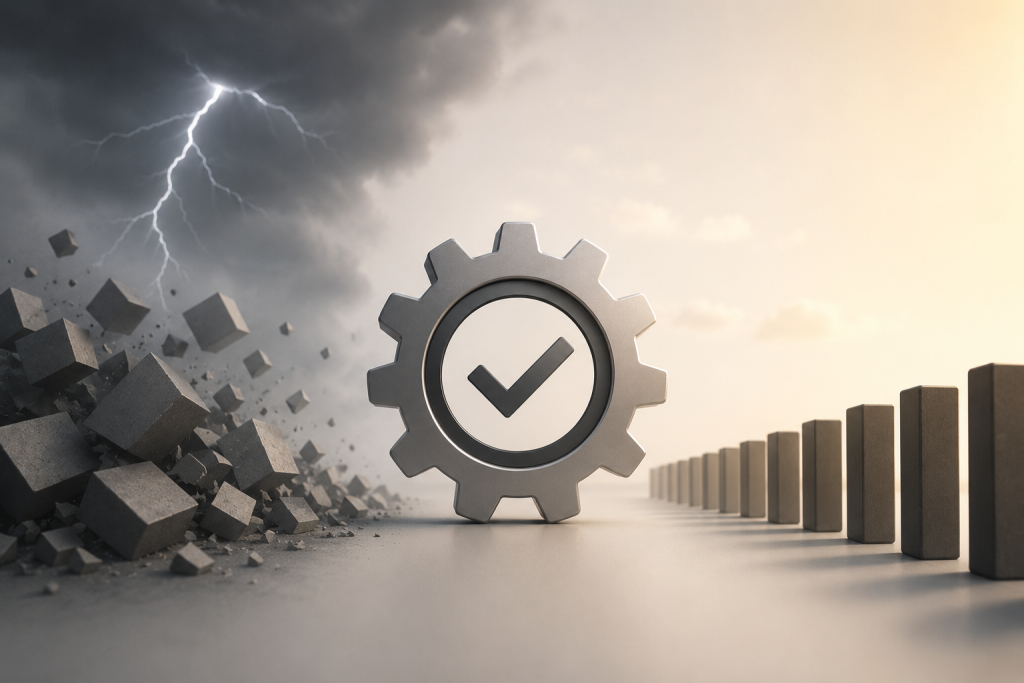
When people hear the word automation, they often think about one thing first: speed.
They imagine systems that do work faster, send updates instantly, process data in seconds, and remove delays from daily tasks. Speed is definitely one benefit of automation. But it is not the main reason automation matters.
The real value of automation appears when pressure gets high.
Automation is not just about doing things quickly. It is about doing the right thing the same way, every time, even when people are tired, stressed, busy, or dealing with unexpected problems. In other words, automation is about consistency under pressure.
Why speed is not enough
A fast process is useful, but speed alone does not guarantee quality.
A person can work quickly and still forget a step. A team can respond fast and still miss an important detail. A company can move at high speed and still create risks if the process is not stable.
This is where automation changes the game.
A well-designed automated process does not get distracted. It does not forget a checklist item because the day is busy. It does not skip validation because a deadline is close. It does not make emotional decisions because pressure is high.
Instead, it follows the logic it was built to follow.
That does not mean automation is perfect. Bad automation can repeat mistakes very efficiently. But good automation creates something very powerful: reliable execution, especially in moments when human consistency becomes harder to maintain.
Pressure reveals the truth about process
Any team can look organized when workload is light.
The real test comes during difficult moments:
- when incidents happen
- when deadlines are close
- when systems fail
- when customer demand suddenly rises
- when key people are unavailable
- when the business needs to react fast
These are the moments when manual processes often start to break.
People forget approvals. Messages are missed. Tasks are duplicated. Documentation becomes outdated. Important checks are skipped because everyone is trying to keep up.
Pressure does not create these weaknesses. It reveals them.
Automation helps reduce this risk by making critical actions repeatable and dependable. It supports people by protecting the process when the environment becomes unstable.
Consistency builds trust
One of the most underrated benefits of automation is trust.
When a process is automated correctly, teams start to trust that:
- alerts will be sent
- reports will be generated
- approvals will follow the same route
- backups will run
- checks will happen before release
- customers will receive the expected communication
This trust is important because strong teams do not only need speed. They need predictability.
Predictability helps leaders plan better. It helps employees focus on work that needs judgment. It helps customers receive a more stable experience. And it helps organizations reduce the cost of human error.
In stressful situations, trust in the process becomes even more valuable than speed.
Automation supports people, not replaces them
Some people worry that automation removes the human side of work. In reality, the best automation usually does the opposite.
It removes repetitive pressure from people so they can focus on decisions, creativity, communication, and problem-solving.
Humans are still needed for strategy, exceptions, empathy, and judgment. But they should not have to spend their energy repeating the same basic steps over and over, especially in high-pressure situations.
For example:
- A security team should investigate real threats, not manually copy the same ticket details every day.
- A finance team should review meaningful issues, not spend hours sending routine reminders by hand.
- A product team should think about users and priorities, not chase the same operational steps every release.
Automation creates space for human work by protecting routine execution.
The best automation is often invisible
Sometimes it is not a robot or a complex AI workflow. Sometimes it is a simple rule, a scheduled task, an approval flow, or a validation step that quietly prevents problems.
Its success is often invisible because nothing goes wrong.
No missed handoff. No forgotten task. No inconsistent message. No emergency caused by a skipped step.
That is the point.
The best automation does not always look exciting from the outside. But inside the business, it creates stability. And stability becomes critical when pressure rises.
A better question to ask
Instead of asking, “How can we make this faster?”, teams should also ask:
How can we make this more reliable when things get difficult?
That question leads to better automation.
It shifts the focus from performance alone to resilience. It helps teams design systems that still work when people are overloaded, when timing is tight, and when mistakes would be expensive.
Because in the end, the true purpose of automation is not only saving time.
It is protecting quality when quality is hardest to maintain.
Final thought
Speed is attractive. Consistency is transformative.
Anyone can appreciate a faster process on a normal day. But the real strength of automation shows up on the hard days – when pressure is high, attention is divided, and failure becomes more likely.
That is when automation proves its value.
Not because it moves faster than people.
But because it keeps working with discipline, structure, and consistency when pressure tries to break the process.